
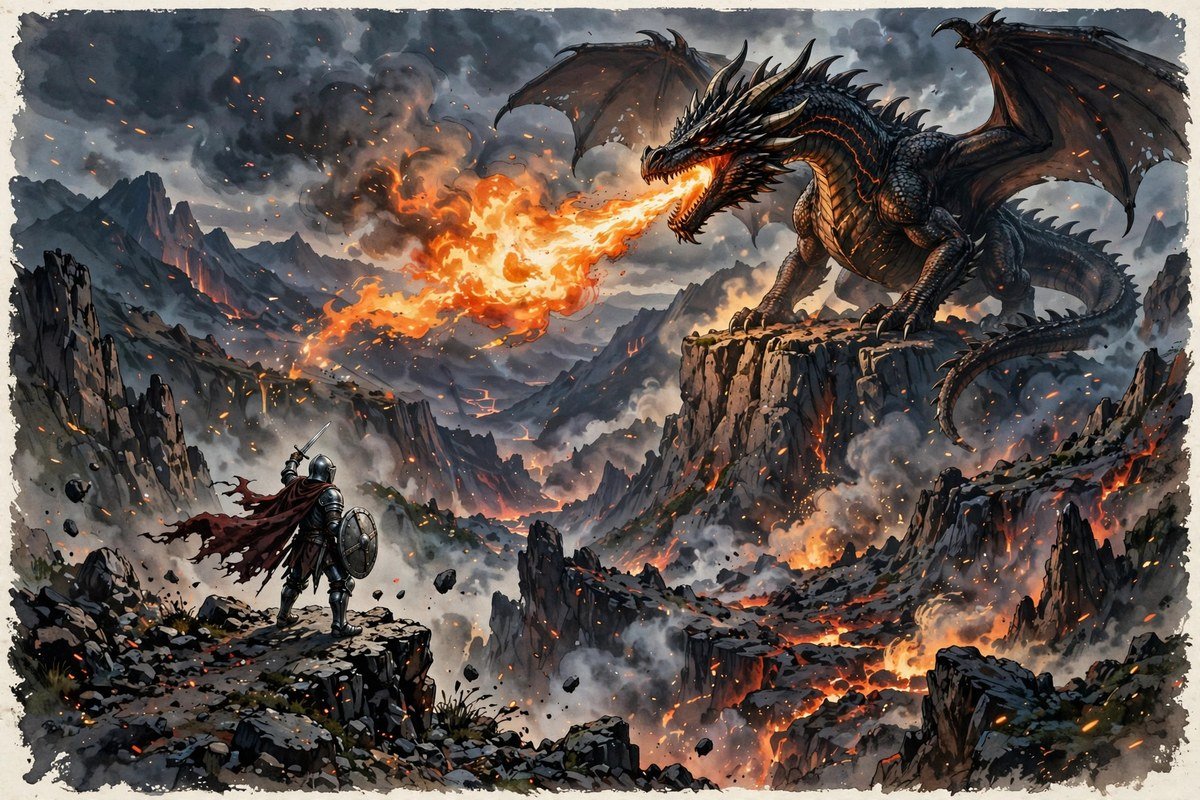
There is a moment in every boss fight when you realise you are going to lose. Your health is low, the boss is barely scratched, and the pattern you thought you understood has just changed. In that moment, you have two choices: panic, or watch. Panic feels productive and achieves nothing. Watching feels like giving up — and it is the only thing that ever wins the fight.
1. The boss is not your enemy. The rush is
Most boss fights are lost in the first thirty seconds, and not because the boss is too strong. They are lost because the player attacks immediately, without learning anything. You run in, swing wildly, take damage, and spend the rest of the fight recovering from a bad start. The boss didn't beat you. Your impatience did.
A good boss fight is designed around this exact weakness. The boss has a pattern — a sequence of attacks, pauses, and openings — and the pattern is visible from the start if you are willing to look. The first attempt should not be an attempt to win. It should be an attempt to observe. Stand at a safe distance. Watch the wind-up before each attack. Count the beats between one move and the next. Notice where the boss is vulnerable, and, just as importantly, notice where it isn't.
This feels counterintuitive, because games train us to act. But the boss fight is a different kind of test. It is not testing your reflexes, or not only your reflexes. It is testing whether you can slow down under pressure — whether you can be hit, survive, and still think clearly instead of flailing. That is a harder skill than dodging, and it is the one that actually wins.
2. Losing on purpose is a strategy
Here is a technique that sounds like surrender and works like a charm: go into a boss fight intending to lose. Not carelessly — attentively. Your goal for this attempt is not to win. It is to learn one thing. Where does the boss attack from? How long is the pause after the big swing? Which attack can you safely ignore, and which one must you dodge every time?
When losing is the plan, the pressure disappears. You stop making desperate decisions. You notice details that panic was hiding from you — the small flash before an attack, the sound cue that precedes a charge, the safe corner where the boss's sweeping attack can't reach. Each deliberate loss buys you information, and information is the currency that wins boss fights.
After three or four of these scouting runs, something shifts. You start to see the fight as a sequence rather than a chaos: attack, pause, dodge, opening, attack, pause. The boss stops being a wall and becomes a rhythm. And once you can hear the rhythm, you can play along with it. The win, when it comes, often feels almost calm — not because the fight got easier, but because you finally stopped fighting yourself.
It is worth keeping a small mental note of what you learn each attempt, even if it is only one thing: the boss always opens with the same attack, or the safe spot is the left corner, or the third swing is the one to dodge. One fact per attempt is enough. By the fifth attempt you have five facts, and five facts are usually all the fight requires. Players who try to learn everything at once learn nothing. Players who collect one fact per loss build the whole picture quietly, attempt by attempt, until the fight that looked impossible is simply a sequence they understand.
3. The pause between attempts
The most dangerous moment in a boss fight is not during the fight. It is the five seconds after you lose, when the retry button is glowing and your frustration is fresh. Most players hit retry immediately, carrying all the tension of the last attempt straight into the next one. They lose faster the second time, and faster still the third, and soon they are convinced the boss is impossible — when what is actually impossible is winning while furious.
The pause between attempts is part of the fight. Take it. Put the controller down. Drink some water. Think about what actually killed you, not in general — "the boss is too hard" — but in particular. Was it the second attack in the sequence? The moment you got greedy and attacked during a wind-up? The corner you backed yourself into? One specific answer is worth more than ten retries.
Some players keep a small ritual for this pause: stand up, stretch, take three slow breaths. It sounds trivial, and it changes the outcome measurably, because a boss fight is as much about your state as it is about your skill. A calm player with average reflexes beats a tense player with excellent reflexes, almost every time. The boss is patient. It will wait. You can afford to be patient too.
4. Greed is the real final boss
Ask any experienced player what kills them most often in boss fights, and the answer is rarely a specific attack. It is greed: the decision to land one more hit when they should have retreated. The boss is at low health, the opening is there, and the player thinks "one more" — and takes a full attack to the face for their trouble.
Boss fights are designed to punish this. The opening after a boss's attack is deliberately short — long enough for one or two hits, never three. The game is teaching you restraint: take what is offered, then step back and wait for the next opening. Players who learn this beat bosses steadily. Players who don't keep dying at the same moment, convinced the game is unfair, when the game has been perfectly fair all along.
This lesson travels further than gaming. The discipline of taking the safe hit and waiting for the next opening — of not risking everything for a slightly faster win — shows up everywhere: in work, in money, in arguments. A boss fight is a small, safe place to practise it. The stakes are imaginary, the lesson is real, and the game will let you repeat it as many times as you need.
5. The win that teaches you nothing, and the loss that teaches you everything
There is a strange truth about boss fights: the easiest wins teach you the least. A boss you beat on the first try, by luck or by overwhelming force, leaves no impression. You move on and forget it. The boss that beats you ten times and then falls on the eleventh — that one you remember. You remember the pattern, the moment it clicked, the exact opening you finally used. The struggle is what makes the victory meaningful, and it is also what makes the skill stick.
That is why the best boss fights are the ones that feel impossible at first. They are not badly designed. They are designed to make you patient, observant, and calm under pressure — and then to reward you for becoming that person. The trophy, if there is one, is almost beside the point. The real reward is the version of you that walks out of the fight: a little steadier, a little more careful, and a little less afraid of losing.
So the next time a boss beats you, don't reach for the retry button in anger. Reach for the pause. Watch, learn, breathe, and go back in when you are ready. Losing well is not the opposite of winning. It is the way winning happens.