
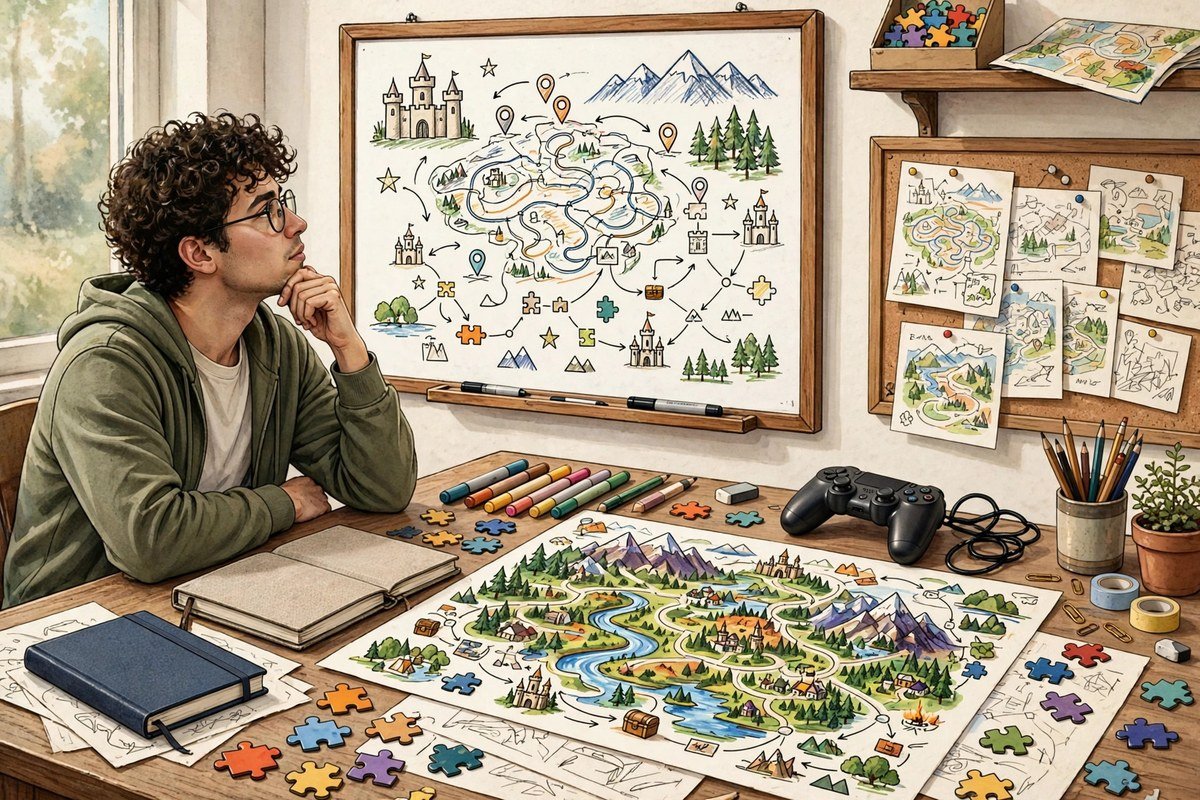
Nobody sits down to play a puzzle game with the goal of becoming better at their job. Nobody loads a racing game hoping to improve their time management. And yet, quietly, without any intention at all, games teach skills that show up everywhere else — in work, in study, in driving, in the ordinary business of getting through a day. The transfer is real, it is well documented, and it happens precisely because you weren't trying.
1. Planning: thinking three moves ahead
The most transferable skill in gaming is also the least glamorous: planning. A puzzle game asks you to look at a board, imagine what happens if you move this piece, then imagine what happens after that, and then decide. That is the same mental movement you make when you plan a week, organise a project, or work out whether you can afford something. The context is different. The thinking is identical.
What makes games such good planning practice is the feedback. In real life, a bad plan can take weeks to fail, and by the time it does, you have forgotten what you decided and why. In a game, a bad plan fails in seconds, and the failure is visible: the move didn't work, the board is worse, and you can see exactly where the thinking went wrong. That tight loop — plan, test, fail, adjust — is how planning skill actually improves, and games run it hundreds of times per hour.
Over time, the habit generalises. Players who spend their evenings thinking three moves ahead in a puzzle start thinking three moves ahead elsewhere — not because they decided to, but because the mental pattern is now familiar. They check the consequences before they act. They keep a backup plan in mind. They notice, earlier than other people, when a plan is going wrong. None of this feels like a skill. It feels like common sense. That is what a well-practised skill feels like from the inside.
2. Patience: the skill nobody wants to practise
Patience is the skill everyone agrees is valuable and nobody wants to practise, because practising patience is, by definition, boring. Games solve this problem by disguising it. A hard level that takes ten attempts to beat is ten attempts of practising patience — waiting for the right moment, resisting the urge to rush, accepting that progress is slow — and it never feels like a lesson, because you are too busy playing to notice.
The patience games teach is a specific kind: patience under frustration. It is easy to be patient when nothing is going wrong. It is hard to be patient when you have just failed for the eighth time and the solution is still not obvious. Games put you in that exact situation constantly, in a safe setting where the stakes are imaginary and the retry button is always there. Each time you take a breath, think instead of flailing, and try again with a clearer head, you are rehearsing a response that will serve you the next time real life frustrates you.
This is not a metaphor. It is the same mechanism. The brain doesn't distinguish sharply between "I am frustrated by this level" and "I am frustrated by this problem at work". It uses the same circuits to manage both, and circuits get stronger with use. The player who has practised staying calm through a hundred failed attempts has a genuine advantage over the player who hasn't — not in gaming, but in everything that requires a cool head.
3. Focus: attention as a muscle
Modern life is an assault on attention. Notifications, messages, feeds, and demands compete for your focus all day, and the ability to concentrate on one thing for twenty uninterrupted minutes has become genuinely rare. Games are one of the few everyday activities that still demand sustained attention — and reward it.
A game that requires focus doesn't just occupy your attention. It trains it. To play well, you have to filter out distractions, track multiple things at once, and hold a goal in mind while dealing with interruptions. That is attention as a skill, and like any skill, it improves with use. Players often notice this without realising what they are noticing: they find it easier to concentrate on a book, or a task at work, after a period of regular gaming — not because games made them smarter, but because they spent their evenings exercising the exact muscle that concentration requires.
The key word is "regular". A single session doesn't build focus any more than a single workout builds strength. But a daily habit of focused play — ten or twenty minutes of genuine concentration — adds up. It is not a replacement for other kinds of focus training. It is a pleasant, low-effort supplement to it, and it has the enormous advantage that people actually do it, because it is fun.
4. Quick decisions: thinking fast without panicking
Some games demand the opposite of patience: instant decisions, made with incomplete information, under time pressure. A fast arcade game gives you a fraction of a second to choose — left or right, jump or duck, shoot or dodge — and the wrong choice costs you the run. This is a different skill from planning, and it transfers differently: not to careful deliberation, but to the moments in life where deliberation isn't possible.
Everyone faces those moments. A ball rolls into the road. A meeting goes off script. A child asks a question you weren't expecting. In those moments, the skill that matters is not careful analysis — there is no time for it — but the ability to act decisively without freezing. Players who regularly make fast decisions in games are practised at exactly this: assessing a situation in a glance, committing to a choice, and adjusting if it was wrong. They are not fearless. They are familiar with acting under pressure, and familiarity is most of what confidence is.
The important detail is that games teach this without real consequences. A wrong decision in a game costs you a run, not a reputation. That safety is what makes the practice possible. You can make a hundred fast, wrong decisions in an evening of gaming, and each one teaches your brain something about deciding quickly — without any of the fear that would stop you from practising in real life.
5. The transfer you don't notice
Here is the honest caveat, because the subject deserves one: games do not make you good at everything. Playing a puzzle game will not make you a mathematician. Playing a racing game will not make you a better driver — in fact, please don't test that one. The skills that transfer are general ones: planning, patience, focus, quick decision-making, persistence. They transfer because they are general, not because games are magic.
But within that honest limit, the transfer is real and worth celebrating. The evening you spent on a puzzle game was not wasted time. It was an evening spent practising how to think ahead, how to stay calm when things go wrong, how to concentrate, and how to decide. You did it for fun, which is why it worked — because the best practice is the kind you don't notice you're doing, and the best skills are the ones you build while you were busy enjoying yourself.
So play. Play for fun, play for the pleasure of it, and let the skills come along quietly in the background. They will show up when you need them — in a meeting, in a deadline, in a moment that requires a clear head — and you probably won't even connect them to the game. You don't have to. The game knows.