
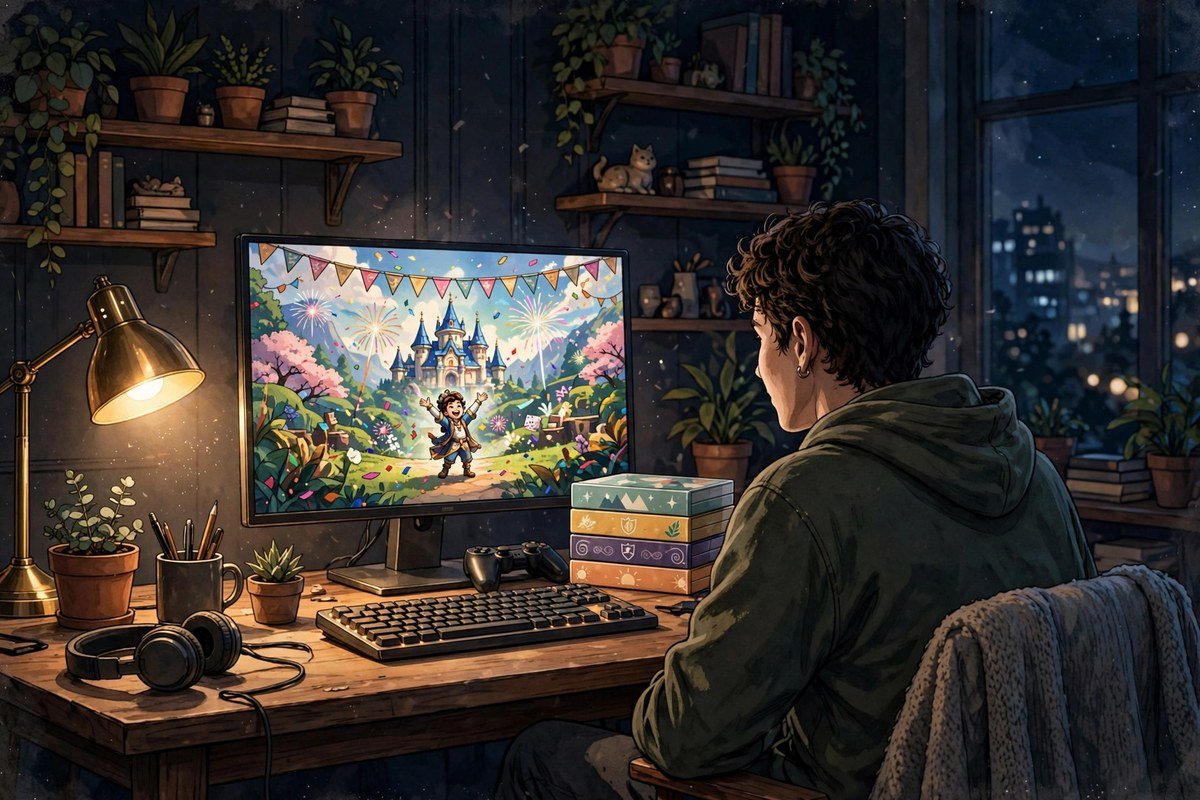
Be honest: how many games have you started and never finished? Not the ones you bounced off after ten minutes, but the ones you genuinely liked, played for a few evenings, and then quietly abandoned somewhere around the middle. If your answer is "most of them", welcome to the club. The unfinished pile is not a sign that something is wrong with you. It is a sign that the way we choose games has very little to do with the way we actually live.
1. Your backlog is a library, not a to-do list
The first thing to fix is the frame. A backlog feels like homework: a long list of obligations, each one silently judging you for not getting round to it. But nobody stands in a library feeling guilty about the books they haven't read yet. The shelves are there to browse, not to conquer. Your game collection works the same way.
I used to keep a spreadsheet. Every game I owned, every game I wanted, colour-coded by priority, with a column for "status" that mostly said "started". The spreadsheet did not make me finish more games. It made me feel worse about the ones I hadn't touched, and it turned the simple pleasure of picking something to play into a small administrative chore. The day I deleted it, I finished a game within the week — not because I had become more disciplined, but because choosing had stopped feeling like an obligation.
Try this instead: stop counting. Let the games you own sit there without a ranking. When you sit down to play, you are not clearing a queue. You are choosing something for tonight, the way you'd choose a film. Some nights you want a two-hour story. Some nights you want twenty minutes of something silly. Both are fine, and neither needs to be justified to a spreadsheet.
2. The twenty-minute test
Here is the most useful trick I know for picking games you will finish: give a new game twenty honest minutes. Not twenty minutes of fiddling with settings or watching an opening cinematic — twenty minutes of actually playing. Then ask yourself one question: do I want to do this again tomorrow?
That question is sharper than "is this game good?" because good is abstract and tomorrow is concrete. A game can be beautifully made, universally praised, and completely wrong for your life right now. If the thought of another session tomorrow feels like a chore, put it down. You have not failed the game. The game has failed the twenty-minute test, and that is useful information, not a defeat.
The test works in reverse too. Some games feel awkward for the first ten minutes — the controls are unfamiliar, the opening is slow — and then something clicks at minute fifteen. The twenty-minute window is long enough to let that click happen and short enough that you haven't invested an evening in something that will never land. It also protects you from the sunk-cost trap: the longer you play something out of duty, the harder it becomes to stop, even when you are not enjoying it.
3. Short games count
There is a quiet snobbery in gaming culture that treats short games as lesser. A game you can finish in an evening gets described as "not much there", as though length were the same thing as value. It isn't. Some of the most memorable games ever made last three or four hours, and they last that long because every minute was designed on purpose.
Think about it from the other direction. A sixty-hour game asks you to hold its story, its controls, and its cast of characters in your head across weeks of scattered sessions. If you play twice a week, you will forget half of what happened between sessions, and the ending will arrive feeling like a reunion with a stranger. A short game fits inside a weekend. You remember the beginning when you reach the end. The whole thing lands as one experience instead of a series of disconnected evenings.
This is especially true on a browser, where the best sessions are often the ones that fit into a gap: a lunch break, a train ride, the half hour before bed. Dego's catalogue is full of games built for exactly that shape of time, and finishing one of them is a real finish. The credits roll, the story resolves, and you get the small, genuine satisfaction of having seen something through. Collect a few of those and the guilt about the sixty-hour epics starts to fade, because you have proof — to yourself, which is the only audience that matters — that you do finish games.
4. One game at a time (mostly)
The single biggest reason games go unfinished is that we play three of them at once. Monday's game gets interrupted by a new release on Wednesday, which gets interrupted by a friend's recommendation on Friday, and by Sunday none of them has your full attention. Each one becomes a little harder to return to, because returning means remembering where you were, what you were doing, and which buttons did what.
The fix is almost embarrassingly simple: one main game at a time. You can keep a second, lighter game around for the odd five-minute gap — something simple you can drop into without thinking — but the game that matters, the one with a story or a progression, gets your evenings to itself until it is done.
This is not a rule about discipline. It is a rule about memory. Games are much easier to finish when the thread stays warm in your head. When you play the same game three nights running, you start dreaming in its logic. You remember the level layout, the character names, the thing you were about to try. That continuity is what carries you through the slow middle section that kills so many playthroughs. The middle of a game is where most people drift away, and the middle is much easier to cross when you haven't spent a week away from it.
5. Quitting is a skill, not a failure
Here is the part nobody tells you: the ability to quit a game cleanly is what makes finishing other games possible. Every hour you spend grinding through something you have stopped enjoying is an hour stolen from a game you might have loved to the end. The guilt that keeps you playing a game you dislike is the same guilt that keeps you from starting the next one with fresh enthusiasm.
So give yourself permission to stop, properly. Not the slow fade where the game sits unplayed for months while you feel vaguely bad about it — an actual decision. "This one isn't for me right now." Say it, mean it, move on. You can always come back. Games do not expire, and neither does your save file in most cases. But the mental shelf-space you free up is real, and it matters.
There is a useful question for the moment of quitting: am I bored, or am I stuck? Boredom is a good reason to stop. Being stuck is a reason to take a break, look something up, or try a different approach tomorrow. Learning to tell those two apart saves you from abandoning games you actually like just because one level frustrated you — and from forcing yourself through games you genuinely don't.
6. A finish line you can actually see
Finally, pick games whose finish lines you can see from the start. Before you begin something new, it is worth knowing roughly how long it is and what "finished" means for it. Is it a story with an ending? A set of levels with a final one? A high score to chase, where "finished" means beating your own best? Games without a clear end can be wonderful, but they are also the ones that dissolve into endless sessions that never feel complete.
When you do finish something, mark the moment. Not with a ceremony — just notice it. Let the credits roll instead of skipping them. Sit with the feeling for a minute. That small pause is what teaches your brain that finishing feels good, and brains that expect a reward at the end are much more willing to start the next one. Over time, you build a small collection of finished games, and each one makes the next finish a little more likely. That is the whole secret. There is no discipline hack, no perfect system. Just games that fit your life, chosen one at a time, with permission to walk away from the ones that don't.