
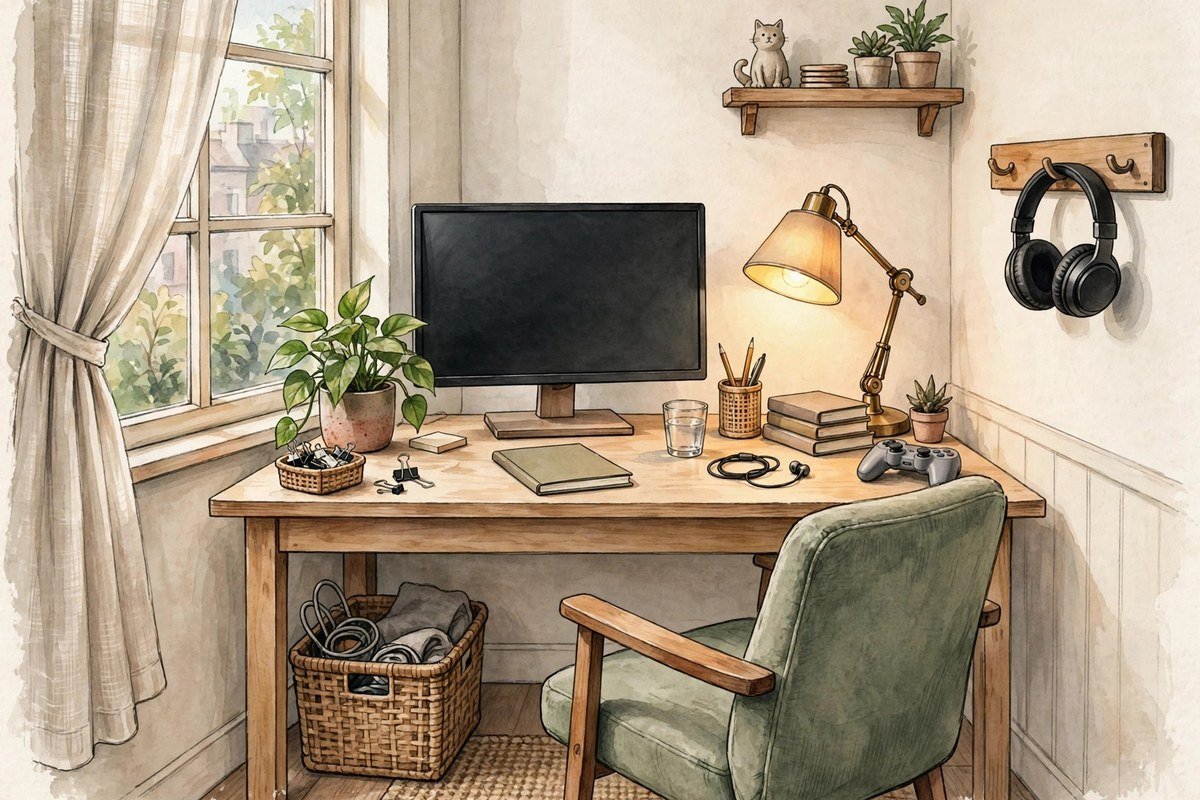
You do not need a gaming room. You do not need a racing chair, a curved monitor, or LED strips in every colour of the rainbow. What you need is a corner — a small piece of your home that is set up for playing, comfortable to sit in, and ready when you are. Everything else is optional, and most of it is less important than the three things that actually matter: how you sit, how you see, and how little effort it takes to start.
1. Start with the chair, not the screen
Every guide to gaming setups starts with the screen, and every guide is wrong. The screen is not the thing your body touches. The chair is. A bad chair will end your session long before a bad screen does — your back aches, your neck stiffens, your shoulders creep up towards your ears, and by the time you notice, you have been uncomfortable for twenty minutes and the game has stopped being fun.
The good news is that a good gaming chair doesn't have to be a gaming chair. The expensive chairs with wings and logos are mostly marketing. What matters is fit: your feet flat on the floor, your knees roughly level with your hips, your back supported at the lower curve of your spine, and your elbows resting comfortably rather than hovering. A solid dining chair with a cushion often beats a flashy gaming chair that forces you into a posture designed for a photoshoot rather than a human being.
If you already own a chair you like, start there and adjust the rest of the setup around it. If your feet dangle, a small footrest — even a sturdy box — changes everything. If your lower back aches, a rolled-up towel tucked behind it does the job of a lumbar pillow that costs ten times as much. Comfort is a matter of geometry, not branding, and geometry is cheap.
2. Light is half the experience
Lighting is the most underrated part of any gaming corner, and the easiest to get wrong. The classic mistake is playing in a dark room with a bright screen, which feels atmospheric for about ten minutes and then starts to hurt your eyes. Your pupils are constantly adjusting between the glowing screen and the darkness around it, and the strain builds up quietly until you have a headache and don't know why.
The fix is simple: a soft light behind or beside the screen, so the room is gently lit and the screen is not the only bright object in your vision. A small lamp with a warm bulb, placed to the side and slightly behind your monitor or laptop, does the job beautifully. It doesn't need to be fancy. It needs to be warm rather than harsh, and it needs to be out of your direct line of sight so it never glares.
Daylight matters too. If your corner is near a window, beware of the screen facing it directly — the glare will wash out the game and force you to squint. Angle the screen slightly, or play with the window to your side rather than in front of or behind you. A ten-degree adjustment to your setup can be the difference between a comfortable evening and a squinting one, and it costs nothing at all.
3. The screen at the right height
The rule is straightforward: the top of your screen should be roughly at eye level, and the screen should sit about an arm's length away. When the screen is too low, you spend the whole session looking down, and your neck pays for it. When it is too close, your eyes work harder than they need to. When it is too far, you lean forward — and leaning forward is the posture that ruins more gaming sessions than any other.
For a laptop, this usually means raising it. A stack of books under a laptop is the oldest trick in the book, and it works perfectly: the screen comes up to eye level, the keyboard tilts slightly towards you, and the whole setup feels immediately more comfortable. If you use an external keyboard, even better — the laptop becomes a screen, the keyboard sits where your hands naturally fall, and your posture straightens out on its own.
For a shared table, the same principles apply in miniature. You are not building a permanent installation. You are arranging a space that takes thirty seconds to set up and thirty seconds to pack away, and that feels good while you are in it. A small tray for your mouse or your phone, a coaster for your drink, a place to rest your elbows — these tiny details are what turn a corner of a table into your corner.
4. Keep it ready, keep it small
The best gaming corner is the one you actually use, and use depends on friction. If setting up takes ten minutes of moving things around, you will skip it on tired evenings. If everything is already in place — the chair, the light, the laptop or the tablet, the bookmark to Dego — then playing is the easiest thing to do in the room, and you will do it.
This is where small beats impressive. A dedicated desk in a spare room sounds wonderful, but if the spare room is cold, or far from the rest of the household, or full of boxes, you will never go there. A corner of the living room, a chair at the kitchen table, a spot on the sofa with a cushion behind your back — these are the setups that survive, because they are where you already are. The gaming corner that shares your life beats the gaming room that doesn't.
Keep the space small and keep it yours. A drawer or a basket for your headphones, your charger, and anything else you need. A hook for a jacket, a shelf for a drink. The goal is a corner that says, without any ceremony, "this is where I play" — and that is ready the moment you sit down.
5. Spend money last, not first
It is tempting to start a gaming corner by shopping: a new chair, a new screen, a new headset, a new everything. Resist it. Play in your corner for a month first, with what you already own, and pay attention to what actually bothers you. Is your neck sore? That is a screen-height problem, and a stack of books fixes it. Are your wrists aching? That is a keyboard position problem. Are your eyes tired? That is a lighting problem.
Only after a month of real use should you spend money — and then spend it on the specific problem you found, not on the setup you imagined. A twenty-pound lamp that fixes your lighting is a better purchase than a two-hundred-pound chair that doesn't fix your posture. The players with the best setups are rarely the ones who spent the most. They are the ones who paid attention to what their body was telling them, and fixed one small thing at a time.
Your corner doesn't need to impress anyone. It needs to feel good at nine in the evening, after a long day, when you sit down for twenty minutes of play. A chair that fits, a light that is warm, a screen at the right height, and a game that opens in seconds — that is the whole setup. Everything else is decoration, and decoration can wait. Start with what you have, fix what actually bothers you, and let the corner grow around the way you really play — not the way a photograph says you should.