
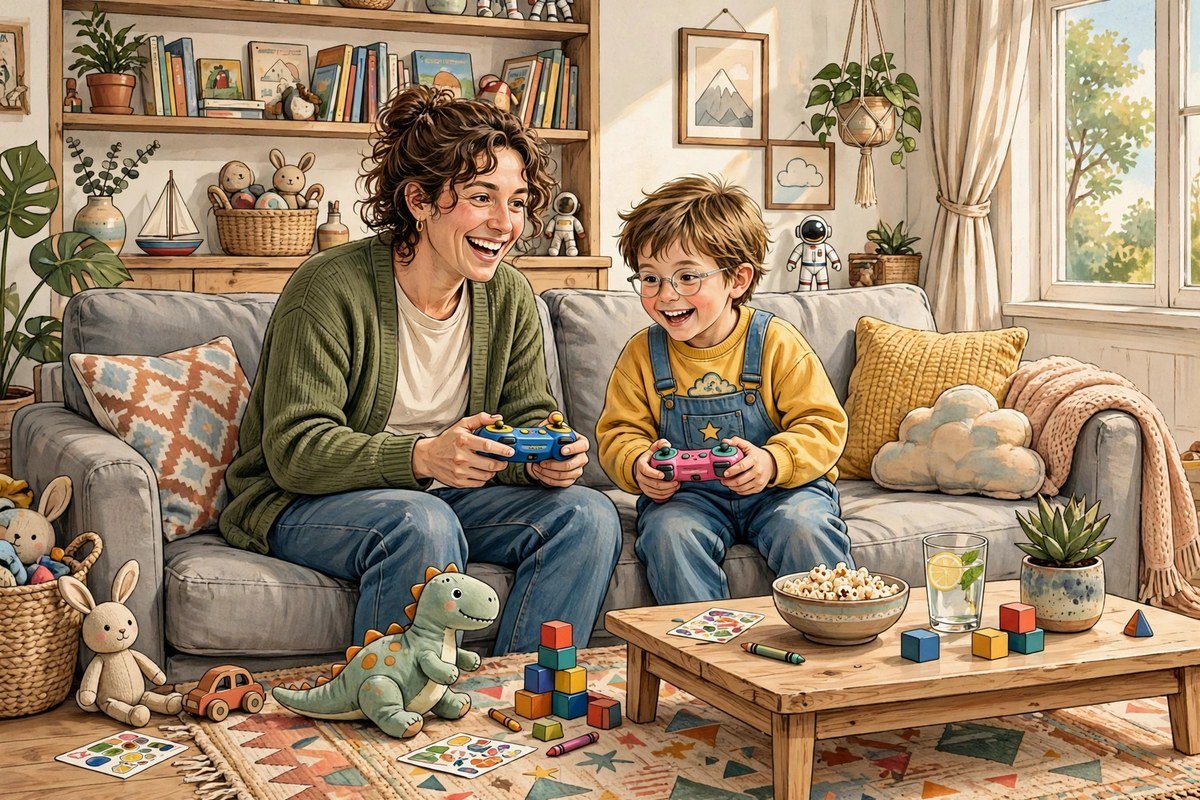
The best parental control ever invented is not a setting, an app, or a timer. It is a chair pulled up next to your child, and an hour spent playing the same game together. You learn more about your child's world in that hour than in a month of asking "how was school?" — what they find funny, what frustrates them, how they handle losing, and what they are genuinely good at. And your child learns something too: that you are interested, that you take their world seriously, and that losing a game to your parent is survivable.
1. Play it first, or play it together
The simplest rule for choosing games for your children is also the most overlooked: play the game yourself, or play it with them the first time. Age ratings and descriptions help, but they are no substitute for ten minutes of actual play. A game rated for young children can still be frustratingly hard, or quietly full of advertisements, or designed to push purchases in ways a rating doesn't capture. Ten minutes of your own play tells you more than ten reviews.
Playing together the first time has a second benefit: it turns the game into a shared experience rather than a solitary one. You can see what your child sees. You can help with the hard part without taking over. You can notice, early, whether the game is kind or cruel — whether it rewards patience or punishes mistakes harshly, whether it celebrates effort or only celebrates winning. A game that is gentle with a struggling player is worth more than a game with the best graphics.
Browser games are particularly good for this, because there is nothing to install and nothing to buy before you can try. You can open Dego, pick a game, and be playing together within a minute. If the game doesn't suit your child, you close the tab and try another. No money spent, no download to uninstall, no argument about a purchase that didn't work out. The low stakes make it easy to explore, and exploring together is half the fun.
2. Difficulty is a parenting question, not a gaming one
Every parent has watched a child hit a wall in a game — the level that won't budge, the boss that won't fall — and wondered whether to help. The instinct is to take the controller and do it for them. Resist it, at least at first. The struggle is where the learning lives, and a child who beats a hard level themselves gains something no amount of help can give them: the knowledge that difficulty is survivable.
That doesn't mean leaving them to suffer. Help takes many forms, and the best ones keep the child in charge. Talk through the problem together: what is the obstacle doing? What have you tried? What haven't you tried? Suggest a break — a genuinely useful strategy, because a frustrated brain solves nothing, and five minutes away often produces the answer. Or play the hard part cooperatively, with you handling one aspect and your child handling the other, so the win belongs to both of you.
The goal is not to protect your child from frustration. Frustration is part of every worthwhile game, and learning to sit with it is a skill that transfers far beyond the screen. The goal is to make sure frustration stays in the productive zone — hard enough to be interesting, not so hard that it becomes despair. When a game crosses that line, the right move is to switch games, not to push through. There are thousands of games. There is no reason to fight the one that is making your child miserable.
3. Time limits that actually work
Every family needs rules about screen time, and every family discovers that rules are easier to write than to enforce. The timers that work best share three qualities: they are agreed in advance, they are consistent, and they have a clear ending that the child can see coming.
"Ten more minutes" fails because it is vague and negotiable. "One more level, then we stop" works better, because a level is a visible, finite thing with a natural end. "We play until the timer rings" works too, as long as the timer is set before the session starts and not introduced as a surprise. The key is that the ending should belong to the structure of the game or the clock, not to a parent's sudden announcement. Children accept limits far more gracefully when they can see them coming.
It also helps to have something good waiting after the game ends. "After this level, we're going to make dinner together" gives the child a reason to stop that isn't just "because I said so". The transition matters more than the limit. A child who is pulled away from a game into nothing will resist. A child who is pulled towards something pleasant will go willingly. And if you play together, the transition is easier still — because you are stopping too, and stopping together feels fair in a way that stopping alone never does.
4. Losing, winning, and being a good sport
Games are one of the safest places for a child to learn about losing. The stakes are low, the loss is immediate, and the chance to try again is seconds away. But children don't learn good sportsmanship from the game itself. They learn it from watching you.
If you lose gracefully — if you laugh, shrug, and say "good game, let's go again" — your child absorbs that. If you throw the controller, blame the game, or sulk, your child absorbs that too, and faster. The same applies to winning. A parent who wins and gloats teaches a different lesson than a parent who wins and says "that was close, you nearly had me". Children are always watching the emotional weather of the adults around them, and gaming is one of the few places where that weather is visible in real time.
Cooperative games are a gift here, because they remove the question of winning and losing against each other entirely. You are on the same side, solving the same problem, and the emotions are shared: the triumph is shared, and the failure is shared too. If your child struggles with losing, start with co-op. The skills they build there — patience, communication, persistence — transfer to competitive games later, when they are ready.
5. What they are actually learning
Parents often ask whether games are "educational", as though the only worthwhile play were the kind that teaches something measurable. The honest answer is that children learn from games constantly — just not always the things on the box. They learn to plan ahead, to manage frustration, to read a situation and adapt, to cooperate with a partner, and to keep trying after failing. These are not small skills. They are the skills that carry a person through school, work, and life.
The games that teach these things best are rarely the ones labelled educational. A puzzle game teaches planning. A racing game teaches focus under pressure. A co-op game teaches communication. A hard boss teaches persistence. The learning is in the playing, not in the label — and it happens whether or not anyone calls it education.
So sit down, pick a game together, and play. You don't need to be good at it. You don't need to understand all of it. You just need to be there, paying attention, and willing to lose a round or two to a seven-year-old who has had considerably more practice than you. That is not a waste of an evening. It is one of the best uses of it there is.