
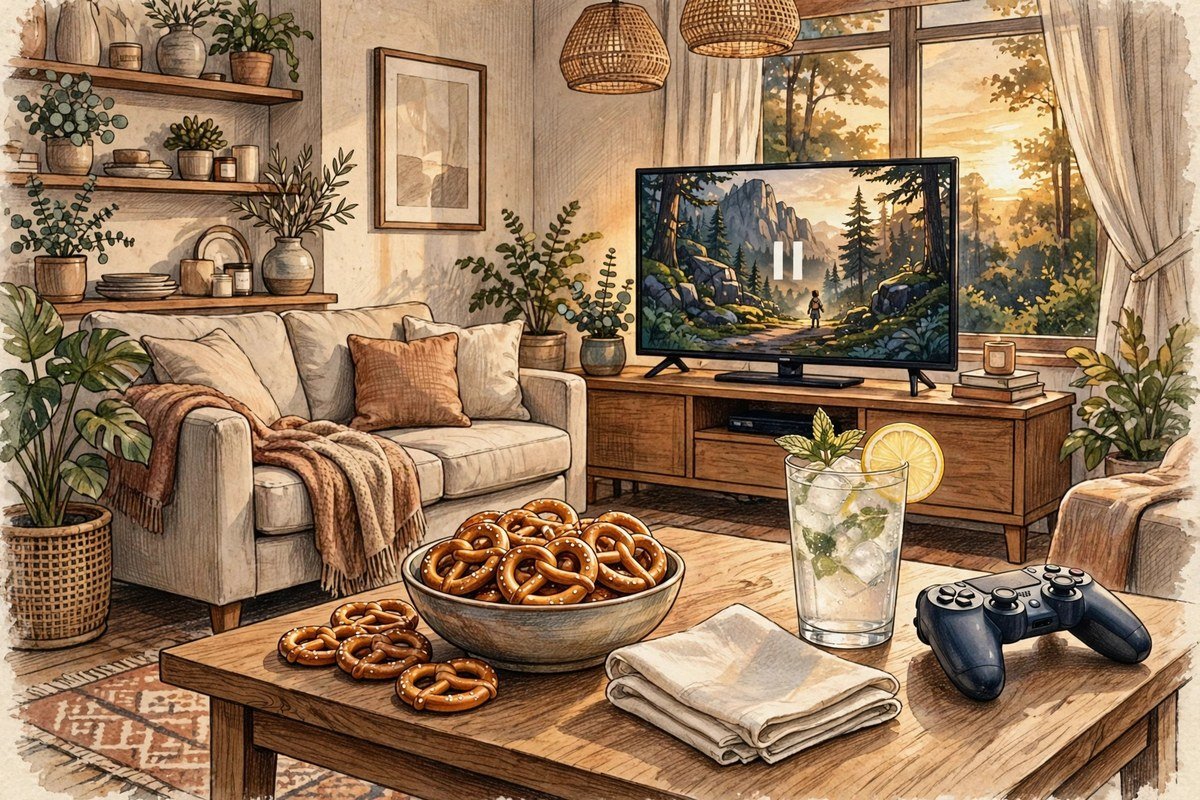
It starts innocently. You are mid-session, the game is going well, and your stomach reminds you that you haven't eaten since lunch. You reach for the nearest thing — crisps, probably, or something from a bag — and twenty minutes later your keyboard sounds different. The keys stick slightly. There is a fine dusting of orange powder across the space bar. You have committed the oldest crime in gaming, and you have done it to yourself.
1. The rules of the road
Good gaming snacks follow three rules, and they are non-negotiable. First, one hand: you should be able to eat it while the other hand stays on the controls. Second, low crumb: nothing that sheds, flakes, or disintegrates over your keyboard. Third, no grease: nothing that leaves a film on your fingers, because a film on your fingers becomes a film on your keys, your mouse, and your screen.
These rules eliminate most of the obvious choices. Crisps fail on all three counts — two hands to hold the bag, crumbs everywhere, and a coating of flavour dust that gets into everything. Chocolate fails on grease and melting. Anything with a sauce fails on principle. The snack aisle is full of foods designed to be eaten with full attention at a table, and gaming is the opposite of that. You need foods that were practically designed for one distracted hand.
The best test is the keyboard test: eat the snack, then touch your keyboard. If your fingers feel clean and dry, the snack passes. If they feel sticky, oily, or dusty, it fails — no matter how good it tastes. Taste matters, but it matters second. The first job of a gaming snack is to stay out of the way.
2. What actually works
The winners are boring, and that is why they work. Grapes are the classic: one hand, no crumbs, no grease, and they come in their own packaging. A small bowl of grapes beside your setup will last a whole session and leave no trace. Berries are the same, though slightly more expensive and slightly more likely to stain if you drop one — eat them over the bowl.
Nuts work well if you buy them unsalted and eat them from a small bowl rather than the bag — the bowl stops you from pouring a handful into your lap, and unsalted nuts leave no dust on your fingers. Dried fruit is good for the same reason, though it can be sticky in warm rooms, so keep the pieces small. Cheese cubes, cut in advance, are surprisingly practical: one hand, no crumbs, and genuinely filling, which is more than you can say for most snack food.
And then there is the humble banana, the most underrated gaming snack in existence. It opens one-handed, it doesn't crumble, it doesn't grease, and it is actually food rather than a flavoured distraction. The only rule is to finish it before it gets too warm, and to keep the peel off the desk. Everything else about it is perfect.
Preparation is the difference between a good snacking session and a sticky one. Cut the cheese before you sit down. Wash the grapes and put them in a bowl. Peel the orange in the kitchen, not over the keyboard. Five minutes of preparation before you play saves you from the mid-session fumble where you're trying to open a packet with one hand while holding a controller with the other — which is how packets end up upside down on the desk and crisps end up everywhere except in your mouth.
3. The drink problem
Food is only half the danger. Drinks are the other half, and they are worse, because a spilled drink doesn't just dirty your keyboard — it kills it. Every gamer knows someone who lost a keyboard, a laptop, or a whole evening to a knocked-over glass. The solution is not willpower. It is physics: put the drink somewhere it cannot fall onto the electronics.
The rule is simple: the drink lives on the far side of the desk, away from your dominant hand, ideally on a surface slightly lower than the keyboard — a side table, a stool, a windowsill. If it cannot physically tip onto the keyboard, it cannot kill the keyboard. A bottle with a cap beats an open glass every time, because a capped bottle can be knocked over without spilling a drop. A mug with a lid is the next best thing. An open glass of anything, perched beside a laptop, is a disaster with a schedule.
Water is the best gaming drink, and not just for safety. Gaming sessions dehydrate you quietly — you are concentrating, your mouth is dry, and you don't notice until you have a headache. A bottle of water within reach, refilled between sessions, keeps you playing longer and feeling better than any energy drink. Save the coffee for before the session, when the caffeine can do its work without the crash arriving mid-level.
4. The ritual of the break
Here is a thought that runs against the whole idea of gaming snacks: the best snack is the one you eat away from the game. A proper break — five minutes, standing up, eating something real, away from the screen — does more for your enjoyment than any bowl of grapes ever will. It rests your eyes, stretches your back, and gives your brain a moment to process what you have been playing. You come back sharper, and the food tastes better because you actually tasted it.
This is especially true for meals. Eating a full meal at your keyboard is a miserable experience for both the meal and the game. The food gets cold, the game gets your divided attention, and you finish neither properly. If you are hungry enough for a meal, pause the game. It will wait. The ten minutes you spend eating properly will improve the next hour of play far more than ten minutes of distracted eating ever could.
That said, there is a place for the in-session snack: the long evening, the game you can't pause, the moment when stopping would break the flow. For those, the bowl of grapes and the capped bottle are your friends. The rule is not "never eat while playing". The rule is "eat like someone who respects their keyboard".
5. The social snack
Gaming snacks change when other people are involved. A solo session wants quiet, clean, one-handed food. A shared session — friends on the sofa, family around the screen — wants food that is part of the occasion: popcorn in a big bowl, passed around between levels; a plate of cut fruit on the coffee table; biscuits with the evening tea. The rules relax because the setting has changed: nobody is worried about a keyboard when the game is on a television and the controllers are in everyone's hands.
Popcorn deserves a special mention here, because it is the great exception to the crumb rule. It sheds everywhere, it gets into everything, and it is still the best shared gaming snack ever invented — because the mess is part of the fun when everyone is making it together. The rule for popcorn is simple: it stays in the living room, far from any keyboard, and the bowl gets passed, not perched. Shared snacks are about the people, not the food, and a little mess is a fair price for a good evening.
So stock the bowl, cap the bottle, and keep the crisps for the sofa. Your keyboard will thank you, your game will run better for the lack of orange dust in its keys, and your snacks will taste better for being eaten properly. The art of the gaming snack is not complicated. It is just this: feed the player, protect the machine, and never let the two get confused.