
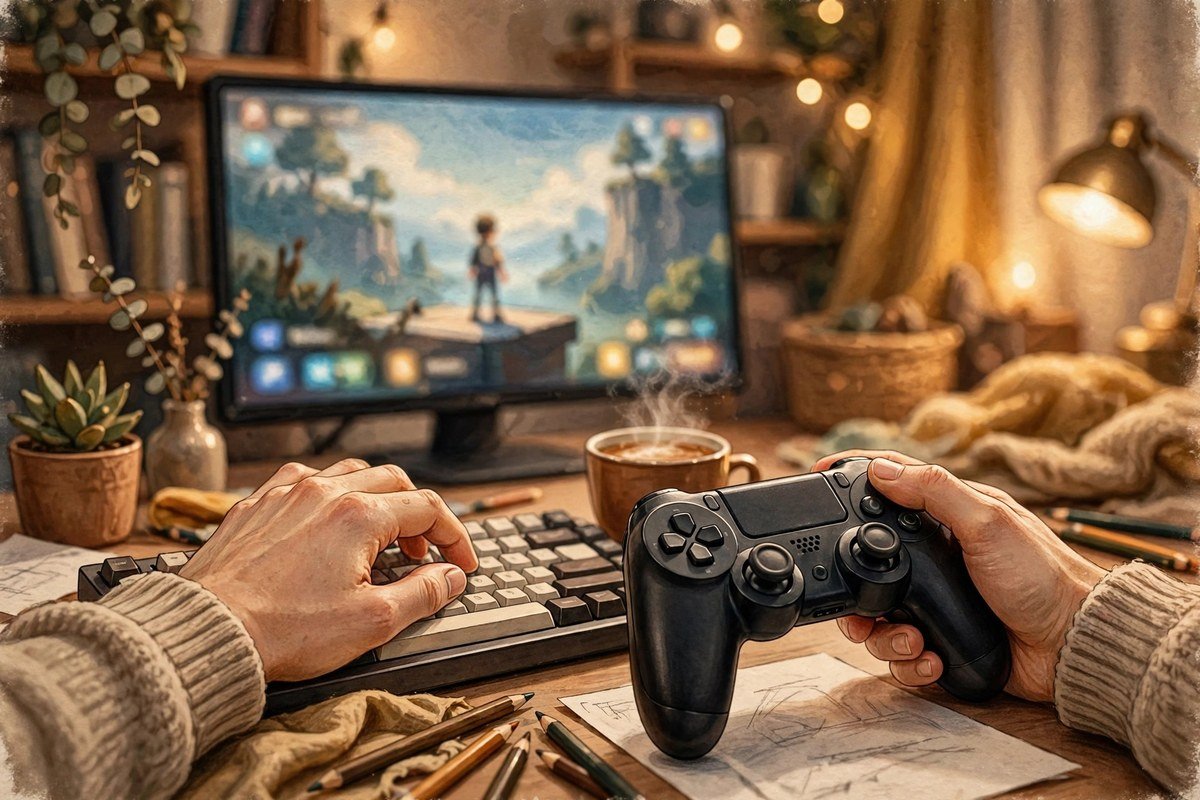
Every player knows the feeling. You start a new game, the tutorial flashes a list of twelve controls, and five minutes later you are hammering the wrong key at the worst possible moment while your character does something embarrassing. It feels like you are bad at the game. You are not. You are just trying to learn the controls with the wrong part of your brain.
1. Your fingers learn faster than your eyes
There are two ways to know a control. The first is declarative: you can recite that Space jumps and Shift sprints. The second is procedural: your thumb moves to Space without you thinking about it at all. The first kind lives in your conscious mind and is slow. The second kind lives in your hands and is fast — but it only forms through repetition, not through reading.
This is why staring at the control screen rarely helps. You can memorise a list perfectly and still fumble in the middle of a level, because the moment you need to jump, your conscious mind is busy with the game itself: the obstacle, the timing, the enemy. There is no spare attention left to translate "jump" into "Space". The translation has to happen automatically, and automatic only comes from doing.
Think of it like learning to type. Nobody becomes a fast typist by studying a diagram of the keyboard. You become one by typing badly for a while, then slightly less badly, until one day your fingers know where the letters are and your eyes are free to look at the screen. Game controls work exactly the same way. The awkward stage is not a sign of failure. It is the only road to the fluent stage.
2. Learn three buttons, then play
Most games front-load their tutorials with everything at once: movement, jumping, sprinting, attacking, dodging, interacting, pausing, crouching, and three special abilities you won't need for an hour. Your brain cannot hold all of that while also learning the game. So don't try.
Instead, learn the three controls that matter right now — usually move, jump, and one action — and ignore the rest until the game actually asks for them. When a new ability appears, the game will teach it to you in context, which is precisely when you are most likely to remember it. A control learned in the moment you need it sticks far better than one learned from a list ten minutes before it becomes relevant.
This also means you should resist the urge to remap everything before your first session. Default controls are defaults for a reason: they were designed around the game's rhythms, and thousands of players learned them as they are. Play with the defaults first. If, after a few sessions, one key genuinely fights your hand — your pinky cramps, or you keep hitting the wrong neighbour — then change that one key. Changing everything at once just resets the learning process.
3. Slow practice beats fast failure
Here is a counterintuitive truth: the fastest way to get good at controls is to go slowly on purpose. When a new move feels clumsy, most players respond by trying it faster, in harder situations, under pressure — and failing, which teaches their hands nothing except panic. The better approach is to find a safe corner of the game and practise the move with no stakes at all.
Jump the same gap ten times with nobody chasing you. Practise the dodge roll in an empty room. Run the combo against a wall. It feels silly, and it works, because your hands need calm repetitions to build the pattern. A dozen relaxed attempts teach more than a hundred panicked ones. Once the movement feels boring — once you can do it while thinking about something else — it is ready for the real game.
This is also why warming up matters. Your first five minutes in any session are your worst five minutes, even in a game you know well. Your hands are cold, your timing is off, and the controls feel slightly foreign again. Treat those minutes as a warm-up: play something easy, repeat a familiar level, let your fingers remember. By the time you reach the hard part, the controls will feel like yours again.
4. One hand at a time
When controls involve both hands — movement on one side, actions on the other — it helps to let each hand learn its own job separately. Spend a session where you focus only on movement: smooth turns, clean stops, precise positioning. Don't worry about attacking well. Then, in the next session, let movement run on autopilot and focus on the action buttons. Trying to master both halves at once splits your attention and slows both down.
Touch controls deserve the same patience. A virtual joystick and on-screen buttons feel strange at first because there is nothing to feel — no edges, no clicks, no resistance under your thumbs. The trick is the same: short, relaxed sessions, and a willingness to be bad for a while. Many players find that resting their thumbs lightly and using small movements, rather than big dramatic swipes, makes touch controls click much sooner. Big gestures look confident and overshoot constantly. Small ones are boring and accurate.
And if a game offers a choice between touch and keyboard, try both for ten minutes before deciding. Some games that look like touch games play beautifully with arrow keys, and some keyboard games are surprisingly natural on a touchscreen. Your hands will tell you quickly which one fits. Trust them over the game's assumptions.
There is also the question of what to do when a game gives you too many controls at once — the kind with a full keyboard map and a dozen abilities. The answer is the same: ignore most of them. In practice, you will use three or four buttons for ninety percent of the game, and the rest exist for rare situations. Learn the core three, play for a while, and let the rare ones introduce themselves when the game actually needs them. If you try to memorise the whole map on day one, you will remember none of it on day two. Your hands can only absorb so much at once, and they absorb it best in small, useful pieces — one real situation at a time, not one long list.
5. The three-session rule
Here is the timeline that actually works. Session one: everything feels wrong, you die in silly ways, and you consider giving up. Session two: the basic movements start to work, and you catch yourself doing something right without thinking. Session three: the controls mostly disappear, and you are finally playing the game instead of fighting the interface. Three sessions. That is the real cost of learning a new control scheme, and it is much smaller than it feels on day one.
The trap is judging the game — or yourself — after session one. Almost every control scheme feels bad in the first session, including the ones that will eventually feel perfect. The first session is data about novelty, not about quality. If you quit every game after one awkward session, you will never reach the point where the controls vanish and the game begins.
So give it three sessions. If the controls still fight you after that, then the game genuinely might not suit you, and walking away is a reasonable choice. But most of the time, session three arrives with a small surprise: your hands know what to do, your eyes stay on the game, and the thing that felt impossible on Monday feels ordinary on Wednesday. That is muscle memory doing its job — quietly, without any memorising at all.