
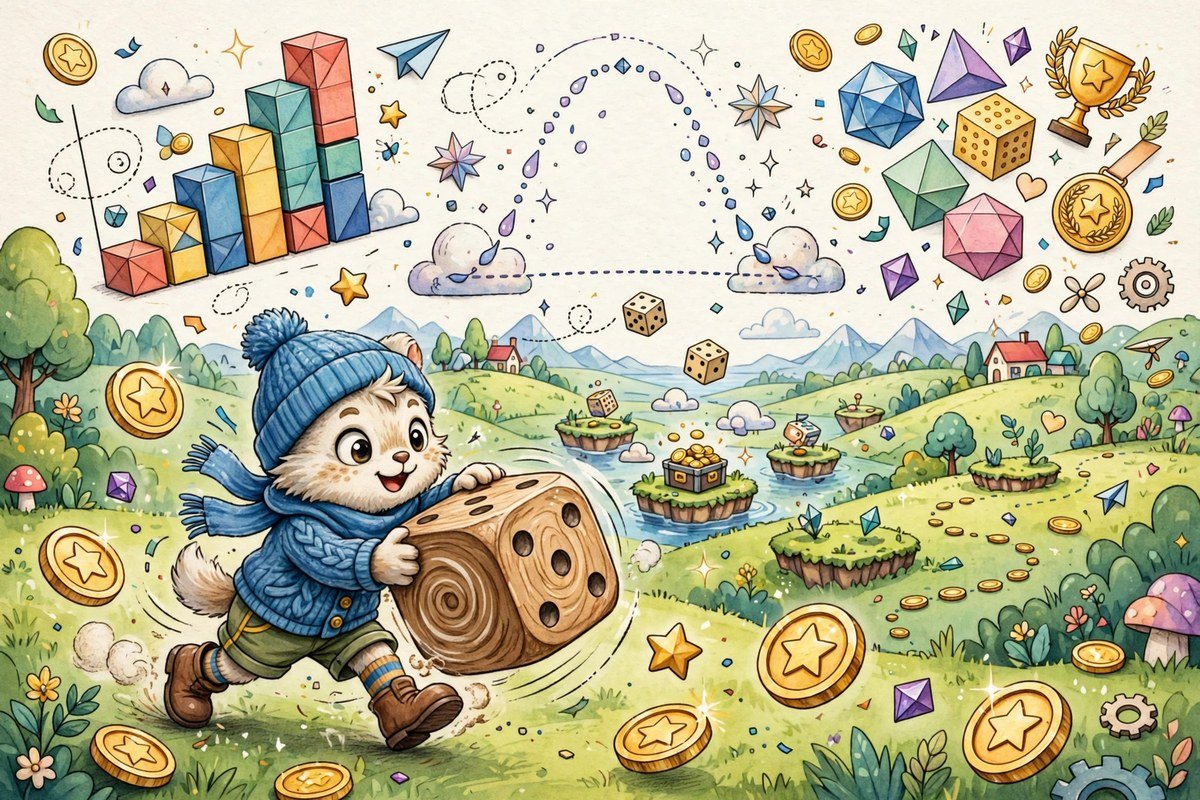
Here is a secret that game designers rarely advertise: every game you have ever loved is a maths lesson in disguise. Not the kind with equations on a blackboard, but the living kind — probabilities deciding whether you find a rare item, geometry deciding whether your jump lands, and scoring formulas deciding whether a risky move is worth it. You have been doing maths every time you play. You just didn't know it, because the game was too busy being fun to tell you.
1. Chance: the dice you can't see
Almost every game involves chance, and chance is just probability wearing a costume. When a game offers you a chest with a ten percent chance of a rare item, it is making a promise in the language of maths: open ten chests, and you will probably — not certainly, but probably — find one rare item. The gap between "probably" and "certainly" is where all the drama lives.
This is why random rewards feel so exciting and so frustrating in equal measure. Your brain is not built to understand probability intuitively. It treats a ten percent chance as a guarantee after ten tries, and feels cheated when the eleventh chest is empty. But probability doesn't owe you anything. Each chest is a fresh roll of an invisible dice, and the dice has no memory. Ten failures in a row at ten percent odds is unlucky, but it is not impossible — and understanding that is the difference between a player who enjoys the gamble and a player who feels the game is rigged against them.
Good game designers understand this quirk of the human brain, and they design around it. Many games quietly improve your odds after a run of bad luck — a system called "pity", where each failure makes the next success slightly more likely. You never see it working, but you feel it: the rare item eventually arrives, and the frustration never quite boils over. The maths is hidden, but its kindness is real.
2. Geometry: the angles that decide everything
Every time you aim, jump, or steer in a game, you are doing geometry — the mathematics of shapes, angles, and distances. When you judge whether a jump will clear a gap, your brain is estimating a curve: the arc of your character's movement, the distance to the far edge, and the speed you need to get there. You do this calculation without thinking, in a fraction of a second, and you are usually right.
The reason you are usually right is that games are designed to make the geometry readable. A gap that looks jumpable usually is jumpable. A target that looks hittable usually is hittable. The designers tune the numbers — the jump height, the gravity, the speed — until the geometry feels fair, so that your instincts match the reality. When a jump feels unfair, it is usually because the numbers are slightly off: the gap is a fraction too wide, the timing window a fraction too tight, and your brain's estimate no longer matches the game's.
Angles matter in subtler ways too. In a game where objects bounce, the angle of the bounce follows a simple rule: the angle coming in equals the angle going out, like a ball off a wall. Players learn this rule through play, without ever being told it, and they start to predict bounces the way a pool player predicts a shot. That is geometry, learned by hand rather than by textbook — and it tends to stick far better than the textbook version.
3. Scoring: the formula that shapes how you play
Every scoring system is a set of incentives in disguise. A game that awards points for speed teaches you to play fast. A game that awards points for accuracy teaches you to play carefully. A game that multiplies your score for consecutive successes teaches you to avoid mistakes — and to take risks to keep the streak alive. The scoring formula is the game telling you, without words, what it values.
The cleverest scoring systems create interesting tensions. Consider a game that gives you more points for collecting items in a risky area than in a safe one. That single decision — worth more points over there — changes how the whole game feels. Safe play becomes a choice with a cost, and risky play becomes a choice with a reward. The maths is simple: more points for more danger. The behaviour it creates is rich: players weighing risk against reward, moment by moment, in a way that feels like instinct but is really arithmetic.
Combo multipliers work the same way. Each consecutive success makes the next one worth more, which means the value of a single move grows as the streak grows. The tenth success in a row is worth far more than the first, so the pressure rises with the reward — and the moment you break the streak, the loss feels bigger than the points, because you lost the multiplier too. That feeling is not an accident. It is the formula, doing its job.
4. Difficulty curves: maths that learns to read you
Have you ever noticed that a game seems to get harder at exactly the rate you get better? That is not a coincidence. It is a difficulty curve — a mathematical shape, designed in advance, that controls how challenge rises over time. The simplest version is a straight line: each level is slightly harder than the last. But the best games use something subtler: a curve that rises gently, plateaus to let you consolidate, and then rises again, like a staircase with landings.
Some games go further and adjust the curve while you play. If you are struggling, the game quietly eases off: fewer enemies, more generous timing, a little extra help. If you are breezing through, it tightens up. This is called dynamic difficulty, and it is maths with a human touch — the game reading your performance and tuning itself to keep you in the sweet spot between boredom and frustration. Most players never notice it happening. They just feel that the game is "well balanced", which is the highest compliment a difficulty curve can receive.
The reason this matters is that the curve is the difference between a game that respects you and a game that doesn't. A bad curve makes you feel stupid for struggling, or bored for succeeding. A good curve makes you feel like you are exactly as good as the game needs you to be, right now — and that feeling, more than any single mechanic, is what keeps you playing.
5. You were doing maths all along
None of this requires you to like maths, or to be good at it in school. The maths in games is learned by doing, not by studying, and it is learned by everyone who plays — including the people who insist they were never any good at numbers. You estimate probabilities when you decide whether to open another chest. You judge angles when you aim a jump. You weigh risk against reward every time you decide whether to play it safe or go for the bonus.
That is worth remembering the next time someone dismisses games as a waste of time. The player working out whether a risky move is worth the points is practising the same kind of thinking that an engineer uses to weigh a design trade-off, or a shopkeeper uses to price a product. The context is different. The thinking is the same. And the player learned it not from a lesson, but from playing — which is, as it turns out, one of the oldest and best ways to learn anything.
So the next time you play, pay attention to the numbers hiding underneath the fun. The dice you can't see, the angles you judge without thinking, the formula that rewards the way you play — they are all there, quietly working, turning your instincts into mathematics. You don't need to understand them to enjoy the game. But understanding them, even a little, makes the game richer. It always does.