
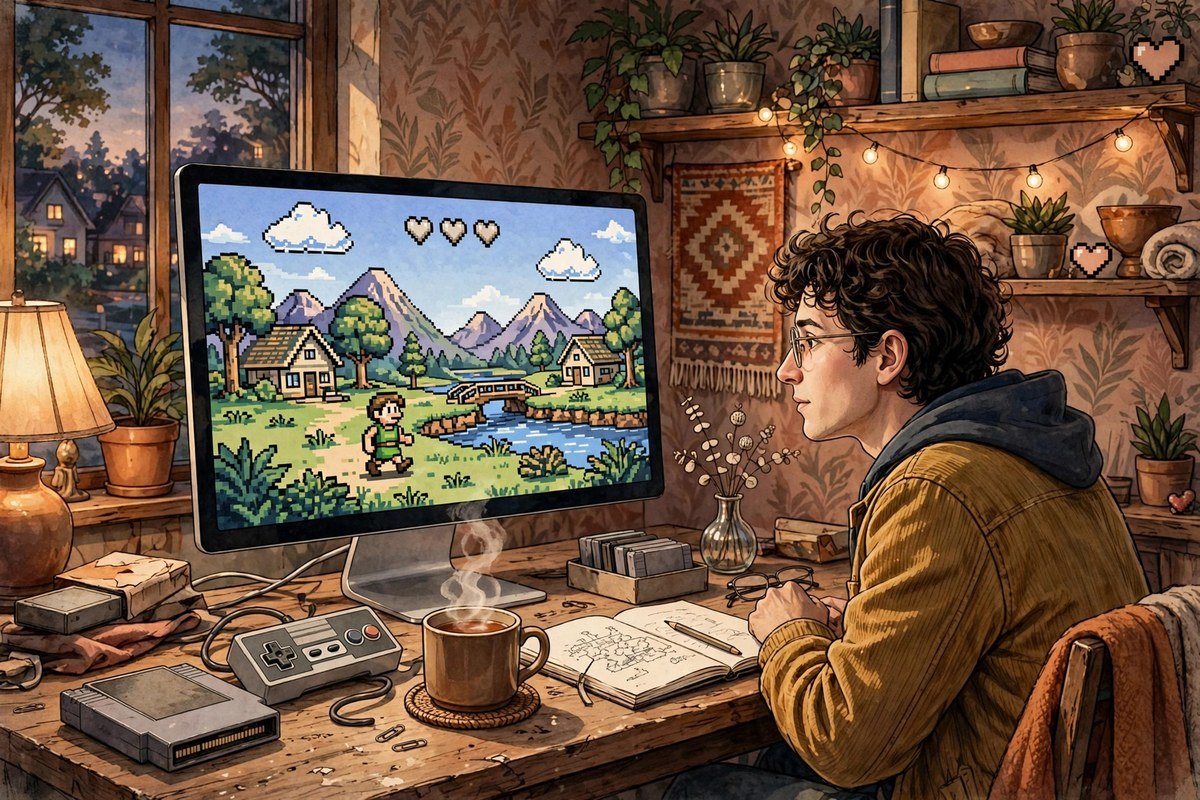
There is a particular pleasure in returning to a game you finished years ago. The opening screen is familiar in the way an old street is familiar: you know roughly where everything is, but the details have softened, and some of them surprise you all over again. People sometimes dismiss replays as nostalgia — as though going back were a failure to move forward. It isn't. A replay is a second game, hiding inside the first one, and it can only be played by someone who has already finished the original.
1. You are not the player you were
The most important thing about a replay is that you have changed since the first playthrough. You are older, more patient, better at games in general — and you notice different things. The puzzle that stumped you for an hour the first time might take five minutes now, not because the puzzle changed, but because you have solved a hundred puzzles since. The story beat that meant nothing to you at seventeen might land hard at thirty, because you have lived the thing the story is about.
This is why replays feel so different from first playthroughs. The first time, you were learning the game: the controls, the rules, the world. You were so busy surviving that you missed half of what was there. The second time, the learning is already done, and your attention is free. You notice the background details, the throwaway lines of dialogue, the clever design of a level you rushed through. The game hasn't changed. Your attention has.
There is also a quiet confidence to a replay that a first playthrough never has. You know the shape of the thing. You know roughly what is coming, and that knowledge lets you relax into the experience instead of bracing for it. It is the difference between visiting a new city and returning to one you love: the first visit is exciting and exhausting; the return is comfortable, and you finally see the streets you walked past the first time.
2. The things you missed the first time
Every game hides things from a first-time player, and not just secrets and collectibles. The most interesting missed things are the structural ones: the way an early level quietly teaches a skill you will need much later, the character who appears in the background of a scene long before they matter, the joke that only makes sense once you know the ending. Designers plant these deliberately, knowing that most players will only catch them on a second visit. A replay is the only way to collect them.
I replayed a puzzle game recently that I had finished three years earlier, and I spent the first hour slightly annoyed at how easy it felt — until I reached a level I had completely forgotten, a level with a mechanic I had never understood the first time around. Back then, I had brute-forced my way through it by trial and error. This time, I saw the logic instantly, and the whole level rearranged itself in my head into something elegant. The game had been elegant all along. I just hadn't been ready to see it.
That experience is common, and it is one of the best arguments for replaying. The first playthrough shows you what a game is. The second shows you what it was trying to be.
Replay value also depends on the game itself. Some games are built for it — short, dense, full of branching paths and details you couldn't possibly catch the first time. Others are built for a single journey, and a replay mostly reminds you that you already know how it ends. Both are fine. The trick is knowing which kind you're holding. A short browser game with a clever mechanic is often a better replay than a fifty-hour epic, because the whole thing fits in your head at once, and the second time through you can appreciate the design instead of just surviving it.
3. Comfort games and hard days
Not every replay is about discovery. Some replays are about comfort. Everyone has a game they return to when life is difficult — a game whose world feels safe, whose rhythms are known, whose challenges are exactly as hard as you remember. Returning to it is less like playing and more like visiting a familiar place. You know where the good parts are. You know nothing in it can truly surprise you. And on a hard day, that predictability is a gift.
There is no shame in this. We reread favourite books and rewatch favourite films for the same reason, and nobody calls that a failure of taste. A comfort game is a tool for managing a bad evening, and it works precisely because it is familiar. The new game you have been meaning to try will still be there tomorrow. Tonight, the old one is what you need, and choosing it is a sensible decision, not a lazy one.
Comfort games also have a practical advantage: they ask nothing of you. No new controls to learn, no new systems to understand, no tutorial to sit through. You can start playing within a minute of opening the game, and your hands remember what to do. On an evening when you are tired enough that even choosing a game feels like work, that frictionlessness matters enormously.
4. Replaying with new eyes — and new people
A replay changes again when you share it. Showing a game you love to someone who has never played it is a replay in disguise: you watch them discover the things you discovered years ago, and their reactions remind you of your own first time. You also see the game through their eyes, and they will notice things you never did — a detail you walked past, a solution you never tried, a joke you never caught.
Children are the best replay companions for this reason. Watching a child play a game you loved is like watching the game get made for the first time. Their questions are the ones you stopped asking years ago: why does that character do that? What happens if you go the other way? Can you just stay here and look at the water? Their curiosity is contagious, and it makes the old game new again in a way no update or remaster ever could.
Even playing alone, it helps to approach a replay as a new player would: try the route you didn't take, choose the option you ignored, play the level you always skipped. The game you finished is not a fixed object. It is a space with more inside it than one playthrough can hold, and every return visit finds something the last one left behind.
5. When a replay disappoints
Honesty requires admitting that not every replay works. Some games don't survive the return. The graphics you remembered as beautiful now look rough. The controls you remembered as tight now feel clumsy. The story you remembered as profound now reads as thin. This is not the game's fault, and it is not yours either. You have both moved on — the game stayed still, and you didn't.
A disappointing replay is still useful, though. It tells you what you actually loved about the game, which is rarely the game itself. You loved who you were when you played it, or the summer it came out, or the friend you played it with. The game was the setting, not the whole memory. Knowing that lets you keep the memory without needing the game to carry it.
And when a replay does work — when the old game opens up and shows you something new, or wraps around you like a familiar coat on a cold evening — it is one of the best feelings gaming offers. Not the thrill of the new, but the deeper pleasure of the known: a game that waited patiently for you to come back, and had something left to say when you did.