
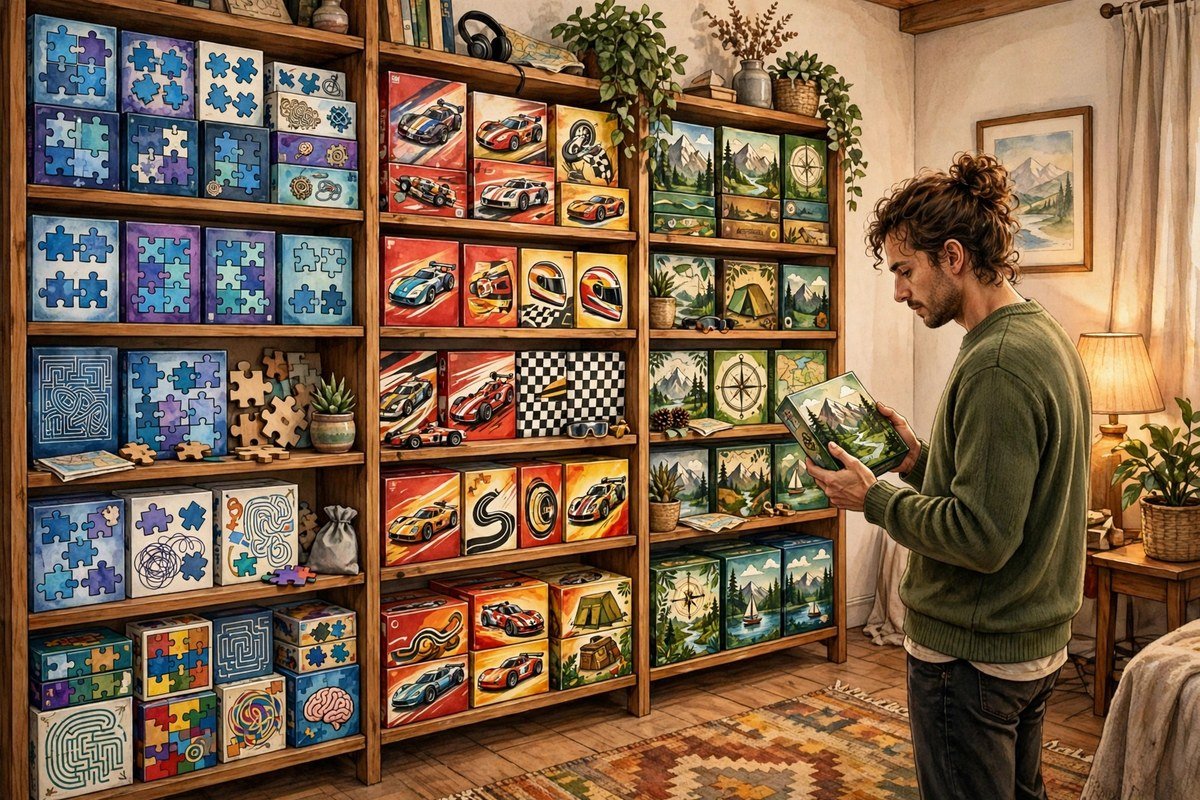
Somewhere on the internet, there is a chart that claims your favourite game genre reveals your personality. Puzzle players are analytical. Racing fans are thrill-seekers. Strategy players are control freaks. It is neat, confident, and mostly nonsense. Your favourite genre does say something about you — but it says it about your life right now, not about your soul.
1. The genre you love is the mood you want
Think about the last time you chose a game. You probably didn't think "I am a puzzle person, therefore I shall play a puzzle." You thought something closer to "I am tired, and I want something gentle" or "I have twenty minutes and I want to feel fast". The genre was a means to a mood, not a statement of identity.
This is why the same person can love a slow, thoughtful puzzle game on a Tuesday and a frantic arcade racer on a Saturday. The person hasn't changed. The evening has. After a long day of decisions, a puzzle can feel like more work — and a racer, which asks nothing of you except reflexes, can feel like rest. After a lazy weekend morning, the same puzzle feels like a delightful challenge, and the racer feels like noise. Genre preference is less like a personality trait and more like an appetite: it changes with the day, the weather, and how much sleep you got.
That is a more useful way to think about it. Instead of asking "what kind of gamer am I?", ask "what do I need right now?" The answer will point you to the right genre for tonight, and tonight is the only session that actually matters.
2. What the genres really offer
Each genre, at its best, offers a particular kind of satisfaction. Puzzles offer the clean click of a problem solved — the moment a pattern resolves and the board makes sense. Racing games offer speed without consequence, the thrill of going fast with no real risk. Strategy games offer the pleasure of a plan coming together over time. Arcade games offer the simple loop of try, fail, try again, slightly better each time.
Notice that none of those satisfactions belongs to a personality type. Everyone likes the click of a solved problem sometimes. Everyone likes going fast sometimes. The genre you return to most often is usually the one whose satisfaction you crave most often — and that craving is shaped by your life. A person whose job is chaotic and unpredictable may love strategy games precisely because they offer order and control. A person whose job is rigid and rule-bound may love chaotic arcade games for the opposite reason. The genre is not a mirror of who you are. It is a counterweight to what your day already gives you.
This also explains why genre tastes change over a lifetime. The teenager who loved fast, loud action games often becomes the adult who loves slow, careful puzzle games — not because their personality was rewritten, but because their days got louder and their evenings got shorter. The genre followed the life.
There is also the matter of who you play with. A genre you would never choose alone can become a favourite when a friend loves it, because the game is no longer just the game — it is the conversation around it, the shared jokes, the rivalry. I know players who insist they hate racing games and yet play one every Friday night, because Friday night is when their brother is free, and the racing game is simply the table they sit at. The genre didn't change their mind. The company did. Ask someone why they love a genre and you will often hear about a person before you hear about a game.
3. The genres you avoid are interesting too
It is tempting to focus on what you love, but what you avoid can be just as revealing — and just as misunderstood. People who avoid horror games are often told they are timid. More often, they simply don't enjoy being startled, or they play late at night and don't want to be wound up before bed. People who avoid competitive multiplayer are often told they are afraid of losing. More often, they play games to relax, and competition is the opposite of relaxing for them.
Avoidance is usually practical, not psychological. You avoid a genre because of what it costs you: time, attention, emotional energy, or the risk of an argument with a stranger online. Those are sensible calculations, not character flaws. And they are reversible. The person who avoids strategy games because they seem slow might love one once they find a version that moves at their pace. The person who avoids puzzle games because they seem hard might discover they love them once they find one that starts gently.
The honest version of the internet chart would say: your least favourite genre is the one that asks for something you don't have spare right now. That is not an insult. It is information.
4. Genre-hopping is a skill, not indecision
There is a quiet pressure in gaming culture to have a "main" genre — to be a puzzle person, or a racing person, as though loyalty to one kind of game were a virtue. It isn't. The players who enjoy games the most over the longest time are usually the ones who wander. They play a puzzle for a week, a racer for a weekend, a word game on the train, and something entirely new whenever curiosity strikes.
Genre-hopping keeps your brain fresh. Each genre exercises a different kind of attention: puzzles reward patience, racers reward reflexes, strategy rewards planning, arcade games reward persistence. Rotating between them is like rotating exercises — you stay flexible, and you never burn out on one movement. It also protects you from the rut where your favourite genre starts to feel like a chore, because you have been playing nothing else for six months and the pleasure has quietly drained away.
If you have always played one genre, try a deliberate experiment: one week, one different genre, ten minutes a day. You do not have to love it. You only have to notice what it feels like. Most players who try this discover at least one surprise — a genre they had dismissed that turns out to suit them perfectly, in a way they never expected.
5. So what does your favourite genre say about you?
Here is the honest answer, stripped of the internet's fortune-telling: your favourite genre says that you found something that fits your life right now. It fits your time, your energy, your mood, and the shape of your evenings. That is a real and meaningful thing — it just isn't a personality diagnosis.
It also says something kinder. It says you know what you enjoy, and you come back to it. And the genre you reach for after a long break, the one you missed while you were away, says even more — it is the game your evenings choose when nobody is watching. In a world that constantly tells you to optimise every minute, choosing to spend your free time on something that gives you a small, reliable pleasure is a reasonable and healthy decision. Whether that pleasure is a solved puzzle, a perfect lap, or a high score beaten by a single point, it is yours, and it is enough.
The next time someone tells you your genre reveals your personality, you can smile and agree — and then go and play something completely different, just to keep them guessing.