
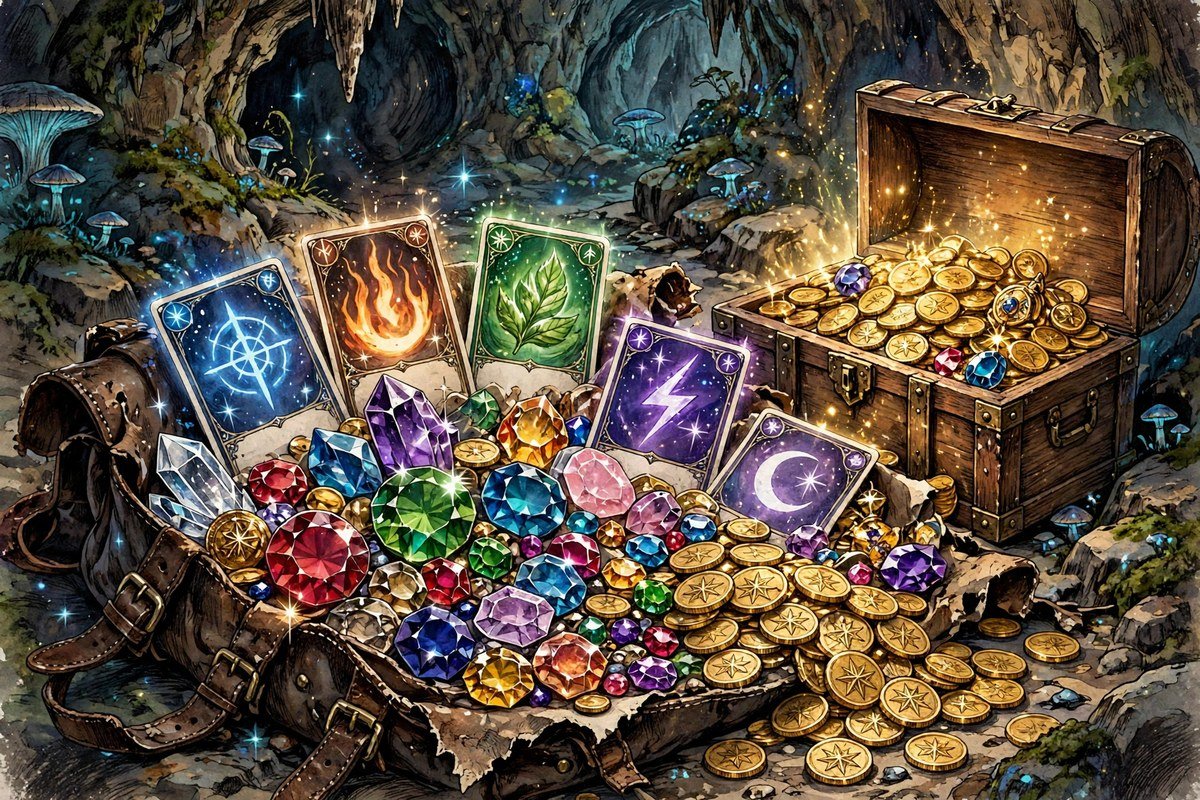
Ask a player why they spent three hours hunting for the last star in a level, and you will get a shrug. There was no reward for it — no new ability, no story twist, nothing the game needed them to have. Just a small icon, now complete, where a gap used to be. And yet the satisfaction of closing that gap was real, immediate, and oddly powerful. The urge to collect things in games is one of the oldest pleasures in the medium, and it runs far deeper than the items themselves.
1. A collection is a map you can see
The first thing a collection does is make progress visible. Most of what you do in a game is invisible: you get better, you learn patterns, you develop judgement, and none of it shows on the screen. A collection changes that. Twelve out of twenty stars. Forty-seven of fifty cards. A gallery that fills up, one item at a time, until the empty spaces are gone.
That visibility matters, because humans are bad at feeling their own progress. We notice the failures — the level we can't beat, the boss that keeps winning — and we miss the slow accumulation of skill underneath. A collection is a record that can't be argued with. It says: you have been here, you have done this, and here is the proof. On a bad day, when a game feels impossible, opening the collection screen and seeing how much you have already gathered is a genuine comfort. The mountain ahead looks smaller when you can see how much of it is already behind you.
Collections also give shape to a game that might otherwise feel shapeless. An open world with no clear goal can be overwhelming — too much space, too many choices, no sense of what to do next. A collection turns that space into a map with markers on it. Go here, find this, then go there. The game stops being a wilderness and becomes a series of small, achievable errands, each one with a satisfying conclusion.
2. The pleasure of the almost-complete set
There is a particular feeling that collectors know well: the almost-complete set. Nineteen out of twenty. One card missing. One star, in one level, that you have tried six times and still can't reach. That single gap exerts a pull far out of proportion to its importance, and game designers know it.
The pull works because of a quirk in how our brains handle incompleteness. An unfinished pattern nags at us. A gap in a sequence feels wrong in a way that an empty collection never does — because an empty collection is a beginning, and a nearly-full one is a promise almost kept. The last item in a set is worth more, psychologically, than the first nineteen combined, because it represents completion itself: the moment the pattern closes and the nagging stops.
This is why the final collectible is often the hardest to find, hidden in the most obscure corner of the game. The designers are not being cruel. They are pacing the pleasure. If the last item were easy, the set would be finished too soon, and the satisfaction would be thin. By making you work for it, they make the completion feel earned — and earned satisfaction lasts longer than easy satisfaction, in games and everywhere else.
3. Collecting as a way of seeing
Collecting changes how you play. A player chasing a set does not rush through levels. They explore. They look behind the waterfall, under the bridge, in the corner that looks like nothing. They play slowly, attentively, and curiously — and in doing so, they see parts of the game that a rushing player never finds. The collection is an excuse to pay attention, and attention is the thing that makes games rewarding in the first place.
This is also why collecting appeals to a different part of the brain than winning does. Winning is about beating something: a boss, a clock, another player. Collecting is about noticing something. It rewards patience over reflexes, thoroughness over speed, curiosity over aggression. Players who don't enjoy competition often love collecting, because it offers the same sense of achievement without an opponent. The game is not trying to beat you. It is hiding things for you to find, and it is delighted when you find them.
Some of the best collection systems understand this and reward exploration rather than repetition. The items are placed in interesting locations, or tied to small puzzles, or hidden in ways that make you look at the world differently. The worst ones reward grinding — the same action, repeated a hundred times, for a random chance at a drop. The difference between those two designs is the difference between a treasure hunt and a chore, and it is worth choosing games that know the difference.
Collections also create a lovely side effect: they give you a reason to revisit places you'd otherwise rush past. A level you finished in two minutes becomes a place to explore for ten, because there might be something hidden in the corner you ignored. The game world gets bigger, not because it changed, but because you started looking at it properly. Players who collect tend to know a game's world better than players who race through it — every hidden path, every odd detail, every place the designers tucked something away for the curious.
4. When collecting stops being fun
Collecting has a shadow side, and honest players know it. There is a point where the pleasure of completion tips into compulsion: you are no longer enjoying the hunt, but you can't stop, because the gap is there and it nags. You play a level you hate for the fifth time, not because it is fun, but because the star is in it. You check the collection screen more than you play the game. The collection, which started as a pleasure, has become a obligation — and obligations are the opposite of play.
The sign that you have crossed the line is simple: ask whether you would still be doing this if nobody, including you, ever looked at the collection screen again. If the hunt itself is fun — the exploring, the puzzle-solving, the discovery — then keep going. If the only thing driving you is the gap, and the activity itself has become a grind, it is time to stop. A complete collection is not worth a ruined evening.
This is also why the healthiest collections are the optional ones. A game that forces you to collect everything to finish is using the urge against you. A game that offers a collection as a side pursuit — there if you want it, ignorable if you don't — respects you. You can chase every star, or you can finish the story and move on, and both choices are correct. The collection is a gift, not a tax.
5. The set on the shelf
There is a reason collecting feels so natural in games: it mirrors something older than gaming itself. People collect stamps, coins, books, shells, ticket stubs — objects whose value comes not from what they do, but from what they mean together. A single shell is a shell. A shelf of shells, gathered over years, is a story about beaches, holidays, and afternoons spent looking down. The collection is a diary written in objects.
Game collections work the same way. The stars, cards, and creatures you gather are a record of where you have been and what you paid attention to. Long after you forget the details of a game, the memory of completing a set stays — the evening you finally found the last one, the level you explored inch by inch, the small triumph of a gap closing. That is what you are really collecting. Not the items. The evenings.